Back Extensions, Bent-Over Rows and Curls: Why Spinal Fitness Training Loads From the Front

Resisting a force from behind, whether lifting, rowing, doing back extensions or bending over to control a load, creates total compression at the L5-S1 joint of more than 1,200 pounds just from stabilizing a 100-pound upper body, and the force of effort across all lumbar joints exceeds 1,700 pounds. That is Dr. John S. Scherger’s analysis as published in Eileen Durfee’s book, Spinal Fitness, and the book adds that the numbers are virtually identical with proper or improper posture. It is the reason all 5 Spinal Fitness steps work from the front of the body, and the reason the book lists back extensions, bent-over rows and standing bicep curls as exercises to approach with caution. Spinal Fitness training is taught at Spinal Fitness Health and Wellness Center, 214 E. Albany Ave, Building E101, Kennewick, WA 99336, where members hold 24/7 access by door code once their training is complete. Every Thursday from 2 to 6 PM the center is open to new visitors for a free session of one rotating service: the BioCharger NG, the 7 Wave light panel, Brown’s Gas, PEMF or the hot sauna exercise room. Evaluations and training are booked appointments.
Why posture does not change the posterior numbers
In the book’s lever model the spinal muscles attach close to the vertebrae, so the effort arm is fixed and short, and the variable left is the resistance arm, the distance between the spine and the load. Against a force from the front, a restored S-curve shortens that arm. Against a force from behind, the book states that the figures are “virtually identical whether the person has proper or improper posture,” and that “there is no ‘correct form’ that makes this direction of movement safe at high loads or high repetition.”
In the book’s anterior-resistance model, the best improper posture needs 282 pounds of effort with 2,166 pounds of compression, while proper structure needs 77 pounds of effort with 1,218 pounds of compression: a 3.5-to-1 advantage in effort and about 1.8-to-1 in compression. “The spine has excellent mechanical advantage against anterior forces. It has poor mechanical advantage against posterior forces.”
The caution list, as the book writes it
The book’s list of exercises and work patterns to approach with caution is back extensions, bent-over rows, standing bicep curls, repetitive forward bending under load, and any exercise where the posterior spinal muscles are the primary movers. It states the limit of the rule in the same paragraph: “This is not a prohibition on all posterior-chain activity – deadlifts and Olympic lifts performed under expert coaching have their place.” The working principle is not to load the posterior spine repeatedly against resistance as a training strategy, and to reduce prolonged forward-bent work postures where possible.
The adaptation principle behind it
The book attributes the system to 1 principle Scherger demonstrated mathematically: “the human body adapts to the effects it is consistently subjected to.” To adapt toward the S-shaped posture, the book states, the body must be subjected to “gravity and resistance applied from the anterior direction.” The 5 steps therefore load from the front: Back Trac rolling, the Pelvic Tilt over the PowerCushion with resistance over the front of the pelvis, the Sit-Up over the PowerCushion, Neck Flexion against gentle resistance, and the Spinal Twist with supported rest on the Neck and Back Shaper rolls.
For the front-loaded Sit-Up over the PowerCushion with a 100-pound upper trunk, the book’s proper-posture figures are 170 pounds of effort, 1,176 pounds of total compression and zero total shear across 6 joints, worked by 2 muscles, the external obliques.
What changes in a strength program
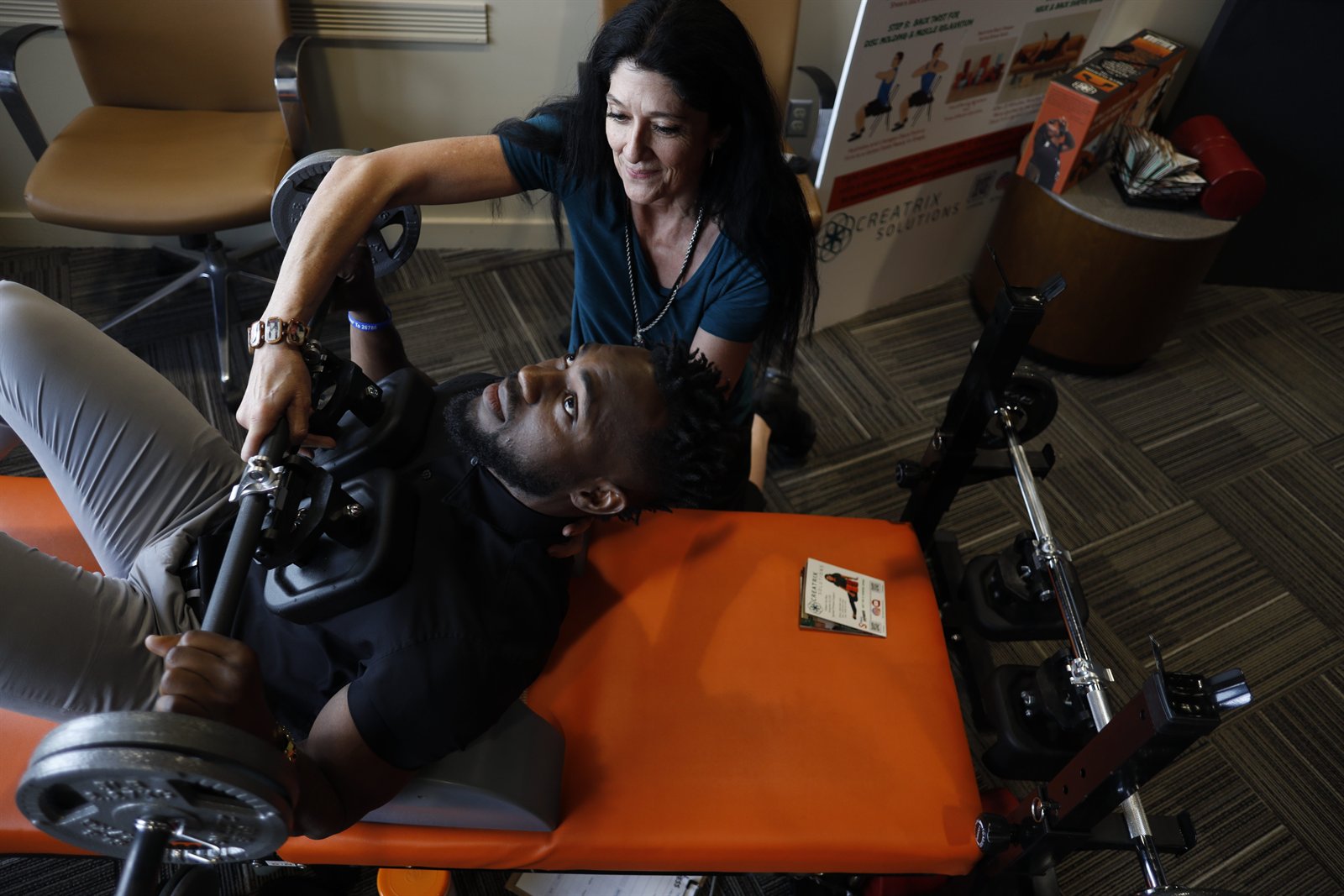
The book’s training sequence is “structure first, strength second.” Its 5-phase correction loop runs decompression, load correction, structural rebuild, cervical integration and stabilization, and its trainer instruction is not to skip phases because a client is eager or strong. For lifts that stay in a program, the book uses the Neck and Back Shaper rolls as braces: on the leg press or hack squat to keep the low-back curve from flattening, and on the bench press to keep the rib cage, pelvis and shoulder girdle aligned. Pain, numbness, tingling and dizziness are the book’s stop signs: stop, get evaluated, and continue with a therapeutic exercise program designed by a Spinal Fitness expert.
Booking in Kennewick
The 60-minute Spinal Fitness Evaluation ($150) covers the back-pain history, 20 minutes over the rolls, a PostureScreen software scan with a printed report, and the first therapeutic exercises. One-on-one training with Eileen Durfee, an NASM Certified Personal Trainer, is $50 a session or $250 for 6 sessions; the initial training session runs 30 minutes and follow-up sessions run 20 minutes. Call or text 509-670-9713, evenings and weekends included. From 214 E. Albany Ave, the center serves Kennewick, Pasco, Richland, West Richland, Benton City and Walla Walla.
Keep Exploring
This article is for educational purposes only.