
If you have been searching for exercise for bone health in Kennewick, this page covers how exercise is dosed at Spinal Fitness Health and Wellness Center, 214 E. Albany Ave, Building E101, Kennewick, WA 99336, and why the mineral literature and the Spinal Fitness method both put the dose ahead of the effort. A program here starts with a 60-minute Spinal Fitness Evaluation at $150 and continues in 20-minute training sessions at $50. To book an evaluation, call or text 509-670-9713.
What the mineral literature says about exercise and calcium
David Watts of Trace Elements, Inc. wrote in 1986 that immobilization or prolonged bed rest increases urinary calcium excretion, and that exercise decreases it. The same Trace Elements paper states that a negative calcium balance of as little as 40 mg per day can remove bone calcium at 1.5% per year, a substantial loss over 20 to 30 years. Watts also recorded that protein makes up approximately 30% of bone.
The ceiling on exercise comes from the Analytical Research Labs (ARL) 1991 paper on bone mineral. It cites studies of women runners in which moderate exercise improved bone density, while the women who exercised beyond a certain amount had lower estrogen and lower bone density. In the ARL account, fast oxidizers already excrete calcium, magnesium and zinc under stress, and a magnesium deficiency raises cortisone secretion, which increases bone turnover.
The same ARL paper gives the slow-oxidizer mechanism, with elevated calcium and magnesium and low sodium and potassium. Sodium and potassium are the solvent elements that keep calcium ionized in the blood; when they fall, calcium leaves the blood and precipitates into tissues, blood calcium drops, and bone calcium is withdrawn to compensate. ARL adds that an underactive thyroid often produces an overactive parathyroid, which mobilizes bone calcium.
ARL’s copper documents describe the mechanism behind training past that point. A person with high tissue copper and a low metabolic rate feels better when running raises the metabolic rate; under that stress zinc is lost and sodium rises. ARL records joggers with shin splints, stress fractures and torn tendons who kept running, and notes that copper dampens pain awareness.
Two opposite bone-density trends on a hair chart
Watts built a Type I and Type II model of bone-density trends from over 100,000 hair tissue mineral analysis profiles. Type I shows a low Ca/P ratio, a low Ca/Pb ratio and a low Zn/Cd ratio, with calcium and magnesium below ideal and sodium and potassium above. Type II shows elevated Ca/P, Ca/Mg and Ca/K ratios with a low Na/Mg ratio. The physical findings also split: Trace Elements lists warm body temperature and night-time muscle cramps with Type I, and cold hands and feet with postural low blood pressure with Type II.
Watts wrote that mineral ratio determinations carry more weight than individual levels, so a bone-density trend is read from the ratios as a set. The center’s hair tissue mineral analysis walkthrough covers the $270 test and its collection.
How the Spinal Fitness method sets a dose
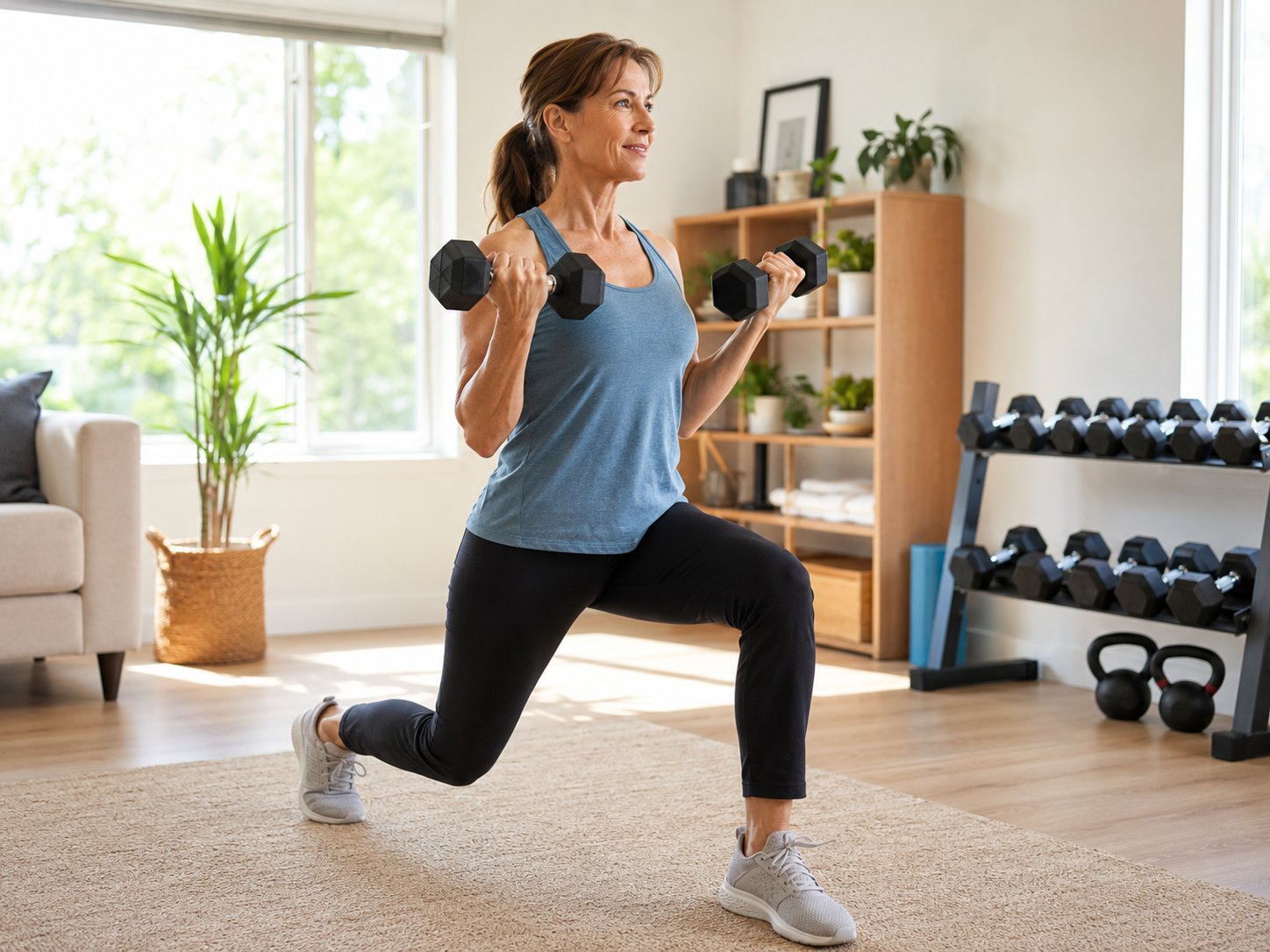
The Spinal Fitness book names three dosing dimensions: duration, intensity and frequency. Of the three, the book states that frequency is the most powerful lever in an exercise program, and that the body adapts to the most consistent stimulus rather than the most intense one. Its micro-dose standard for Neck Flexion is 6 repetitions per session, 6 sessions per day.
Progression follows one rule in the book: reps, range or density rise only when the current dose no longer produces the intended strain, or when form is cleaner with less compensation than in the previous session. The book adds: “Enthusiasm is not a progression criterion.” Its training tracks are Track A at 5 to 10 minutes per day and Track B, for high-exposure work, at 10 to 20 minutes per day, and the sequence is structure first, strength second.
The book’s pain rule for every exercise is “strain is acceptable; pain is not,” and every repetition is controlled, with no speed. New numbness or tingling, radiating symptoms, weakness, bowel or bladder changes, or sharp escalating pain end a session and go to medical evaluation.
Load direction and the spine
The book’s mechanics, from the analysis of Dr. Scherger, compare a proper and an improper spinal structure carrying the same work: 77 lbs of muscular effort and 1,218 lbs of compression with proper structure, against 1,166 lbs of effort and 2,708 lbs of compression without it. The book states that organized compression supports spinal structure and that uncontrolled shear drains it, which is why all five steps of the system work against resistance from the front of the body.
The book also sets a clearance line before any exercise load. It states that a person with known spinal fracture, severely low bone density, unstable spondylolisthesis, active infection or recent surgery does not begin without clinician clearance. That screening happens at the evaluation, before any load is chosen.
The equipment and its doses here
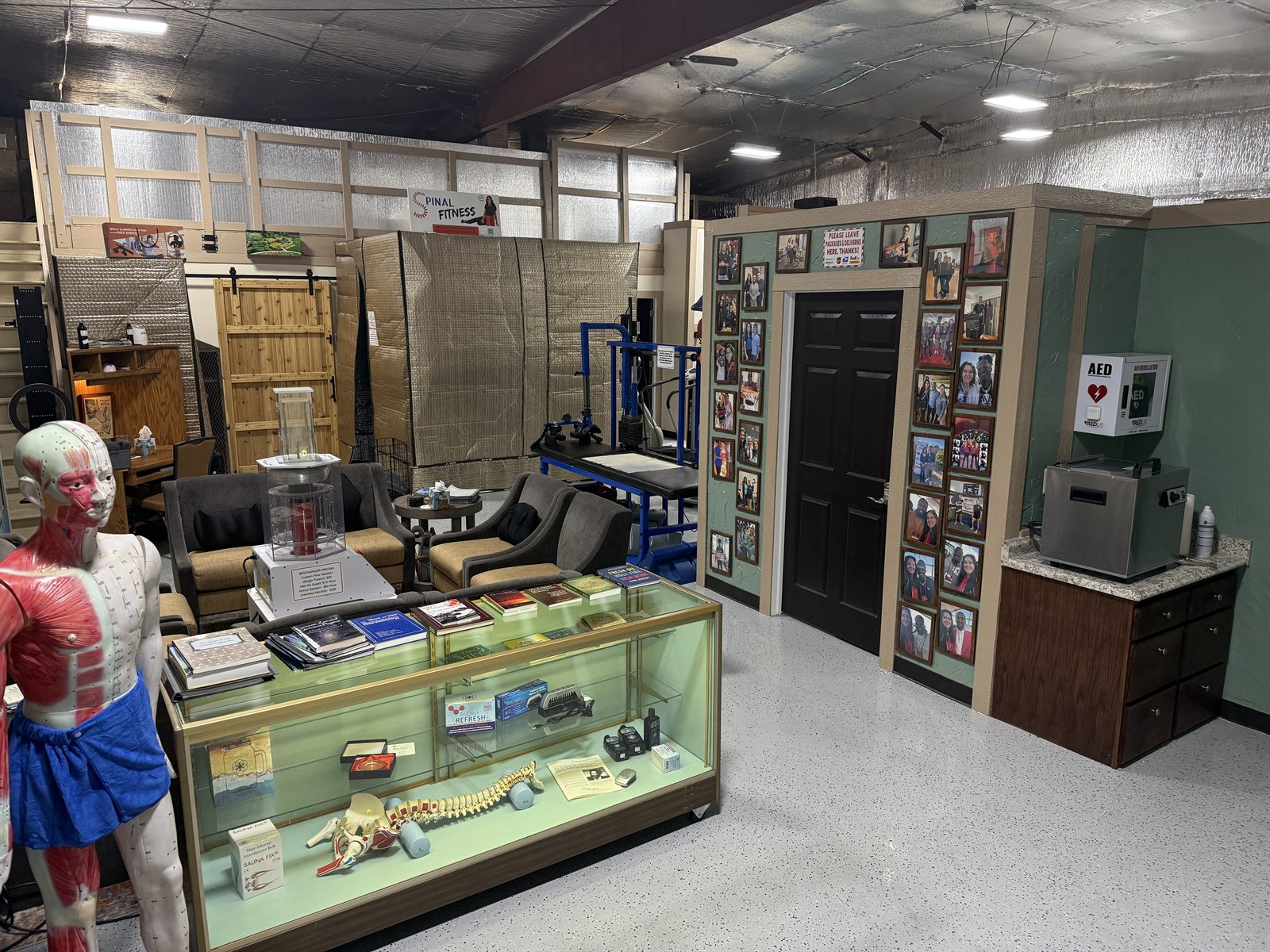
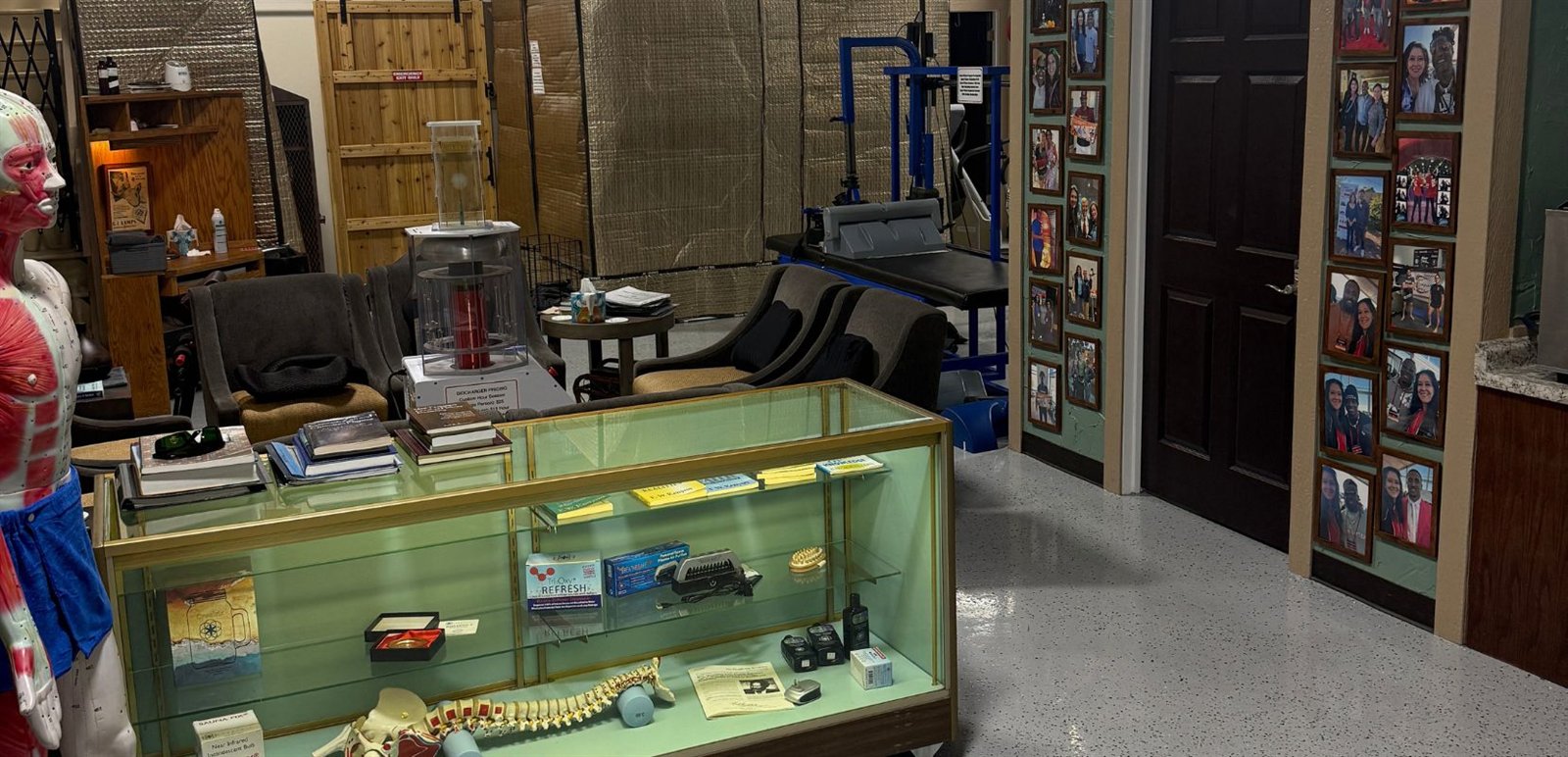
The 24/7 fitness area holds a PowerCore Stepper, an elliptical, a Bowflex TreadClimber, a bicycle, free weights, benches and the spinal fitness training tools. Whole-body vibration sessions run 5 to 15 minutes, beginners start at low settings with knees softly bent, and the plate is excluded during pregnancy and with certain implants, recent injuries or medical conditions.
Training sessions are 20 minutes at $50, booked with Eileen, and the dose in each one follows the book’s progression rule above. After training is complete, a door code is issued, and the $150 monthly membership gives 24/7 access to the same equipment for the book’s Track A daily work, 5 to 10 minutes on each day between sessions.
Who you book with
Eileen Durfee runs every evaluation and training session. She holds NASM-CPT certification, is a Nationally Certified Spinal Fitness Specialist, and wrote the Spinal Fitness book on the mechanics taught by her mentor, Dr. John S. Scherger (1950 to 2016). Eileen holds a NBS (Nutritional Balancing Science) degree, earned through Dr. Larry Wilson’s program beginning in 2011, and has practiced independently since autumn 2017.
Booking an evaluation
Visits are by appointment. Call or text 509-670-9713, evenings and weekends included, and ask for a Spinal Fitness Evaluation, 60 minutes at $150. The center serves Kennewick, Pasco, Richland, West Richland, Benton City and Walla Walla, and the posture assessment guide describes that first hour step by step.
Keep Exploring
This article is for educational purposes only and is not medical advice. Hair tissue mineral analysis is a screening test for nutritional and toxic-element patterns and is not intended to diagnose, treat, cure or prevent any disease. Spinal Fitness Health and Wellness Center is a wellness facility; please consult your own licensed provider before beginning an exercise program, especially with any known bone or spine condition.