Tight Hamstrings and a Forward Trunk: The Hip Force Numbers From the Spinal Fitness Book

With an ideal S-shaped spine and the hamstrings relaxed, hip socket shear is approximately 50 pounds and compression approximately 87 pounds; when the center of upper-body trunk mass sits only 4 inches too far forward, shear rises to 146 pounds, compression to 924 pounds, and the tightened hamstring works at 843 pounds. Those are Dr. John S. Scherger’s figures as published in Eileen Durfee’s book, Spinal Fitness, and the book uses them to explain why tight hamstrings may be overloaded rather than short. Moving the trunk mass forward of the hips lengthens the resistance arm the hamstrings and spinal extensors must work against. The book’s Screen 5 checks hamstring tension by palpation. Spinal Fitness evaluations and training are taught at Spinal Fitness Health and Wellness Center, 214 E. Albany Ave, Building E101, Kennewick, WA 99336. Members hold 24/7 access by door code once their training is complete, and every Thursday from 2 to 6 PM the center is open to new visitors for a free session of one rotating service: the BioCharger NG, the 7 Wave light panel, Brown’s Gas, PEMF or the hot sauna exercise room. Evaluations and training are booked appointments.
The hamstring’s second job
The book states that when the spinal S-shape is lost and the upper trunk shifts forward of the hips, “the hamstrings inherit a second job”: they help keep the trunk from falling forward. That effort produces no stride. In Scherger’s walking and running analysis, with good posture and the trunk balanced over the hip, the planted leg’s hamstring may require essentially zero effort for postural maintenance; with the trunk forward, the same hamstring must generate substantial effort to keep the body upright.
The book’s conclusion on hamstring stretching as a posture fix: “The hamstrings are not always short because they need stretching. They may be overloaded because the spine has lost the structure that should be keeping the trunk balanced.” It calls the hamstrings and spinal extensors “emergency brakes” in this position, and the posterior neck muscles the same when the head moves forward.
What the overload costs elsewhere
The book traces 3 further effects. The first is fiber type. Fast-twitch fibers are recruited for explosive movement; when the posterior chain, including the hamstrings, spinal extensors and hip stabilizers, works continuously to hold the trunk upright, that slow-twitch demand signals the body to convert fast-twitch fibers to slow-twitch. The second is the jump. With trunk mass forward of the hips, the quadriceps muscles drive the body up while the hamstrings work against them to stop the trunk collapsing forward, and the person lands forward of the takeoff point. The third is the knee: the book states that the 87-pound compression figure extends into the knee, and it attributes the added hip and knee load to the change in force direction and the added shear that follow the loss of the spinal S-curve.
How the screen finds it
The book’s posture screen runs in 5 to 7 minutes and scores each item green, yellow or red. Screen 5 is a standing palpation of the neck, lower back and hamstrings. With adequate spinal curves and the trunk balanced over the hips, these muscles “should feel supple and relatively relaxed.” A red result is noticeably firm neck and lower-back muscles, tight hamstrings, and trunk mass visibly forward of the hips. The book adds that an experienced trainer can gently move the upper trunk mass back over the hips and feel the posterior spinal muscles begin to relax, a real-time demonstration of the link between posture and muscle tension.
Screen 1 is side-view stacking: the ear, the shoulder and the greater trochanter in 1 vertical line. Screen 6 is a vertical jump, where a balanced body lands in approximately the same spot it left. The book’s Spinal Fitness Assessment Index then maps the compensation pattern the body prefers under stress, with “hamstring over-bracing” listed beside hip flexor gripping, rib flare and forward head substitution.
What the training changes
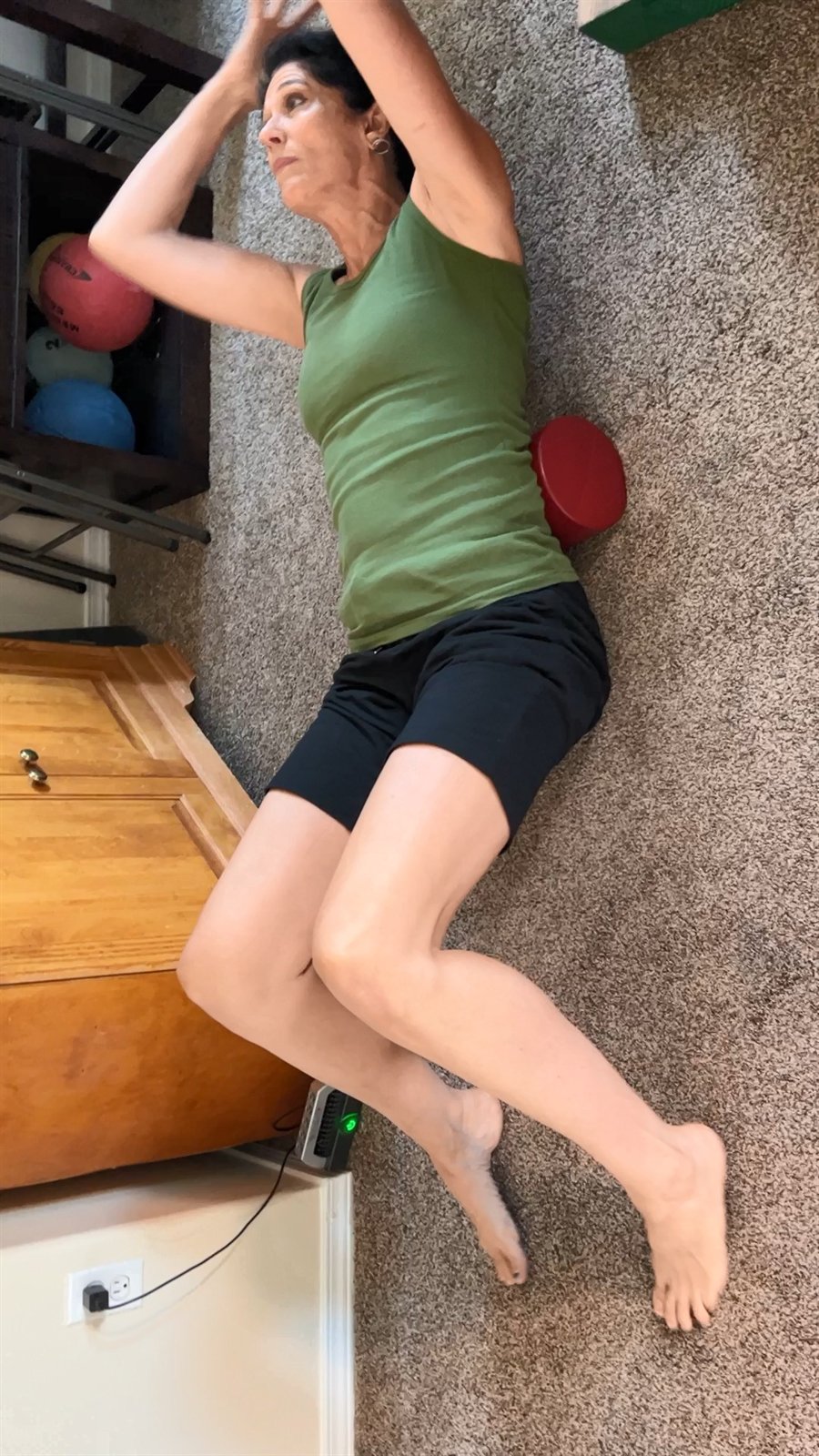
The book’s order of correction is pelvis before spine before head, and its 5 steps all work from the front of the body. The Pelvic Tilt over the PowerCushion targets the L4 to S1 relationship; the Sit-Up over the PowerCushion restores the lumbar curve while the trunk moves against gravity; Neck Flexion brings the head back over the trunk, after which the book states the low back and posterior chain often reduce their background guarding. The book’s progression rule raises reps, range or density only when the current dose no longer produces the intended strain. Pain, numbness, tingling and dizziness are its stop signs: stop, get evaluated, and continue with a therapeutic exercise program designed by a Spinal Fitness expert.
Booking an evaluation in Kennewick
The 60-minute Spinal Fitness Evaluation ($150) covers the back-pain history, 20 minutes lying over the Neck and Back Shaper rolls, a PostureScreen software scan with a printed report, and the first therapeutic exercises. One-on-one training with Eileen Durfee, an NASM Certified Personal Trainer, is $50 a session or $250 for 6 sessions; the initial training session runs 30 minutes and follow-up sessions run 20 minutes. Call or text 509-670-9713, evenings and weekends included. From 214 E. Albany Ave, the center serves Kennewick, Pasco, Richland, West Richland, Benton City and Walla Walla.
Keep Exploring
This article is for educational purposes only.