
The mild hyperbaric chamber at Spinal Fitness Health and Wellness Center in Kennewick, WA pressurizes to 1.3 ATA, 30% above sea-level air pressure, and 3 gas laws describe what that pressure does inside the body: Boyle’s law for the air spaces in the ears and sinuses, Dalton’s law of partial pressures for the oxygen in each breath, and Henry’s law for how much oxygen dissolves in blood plasma. Members hold 24/7 access through a door code issued once their training is complete, and every Thursday from 2 to 6 PM the center is open to new visitors for a free session of 1 rotating service; hyperbaric sessions are always booked.
Where 1.3 ATA sits
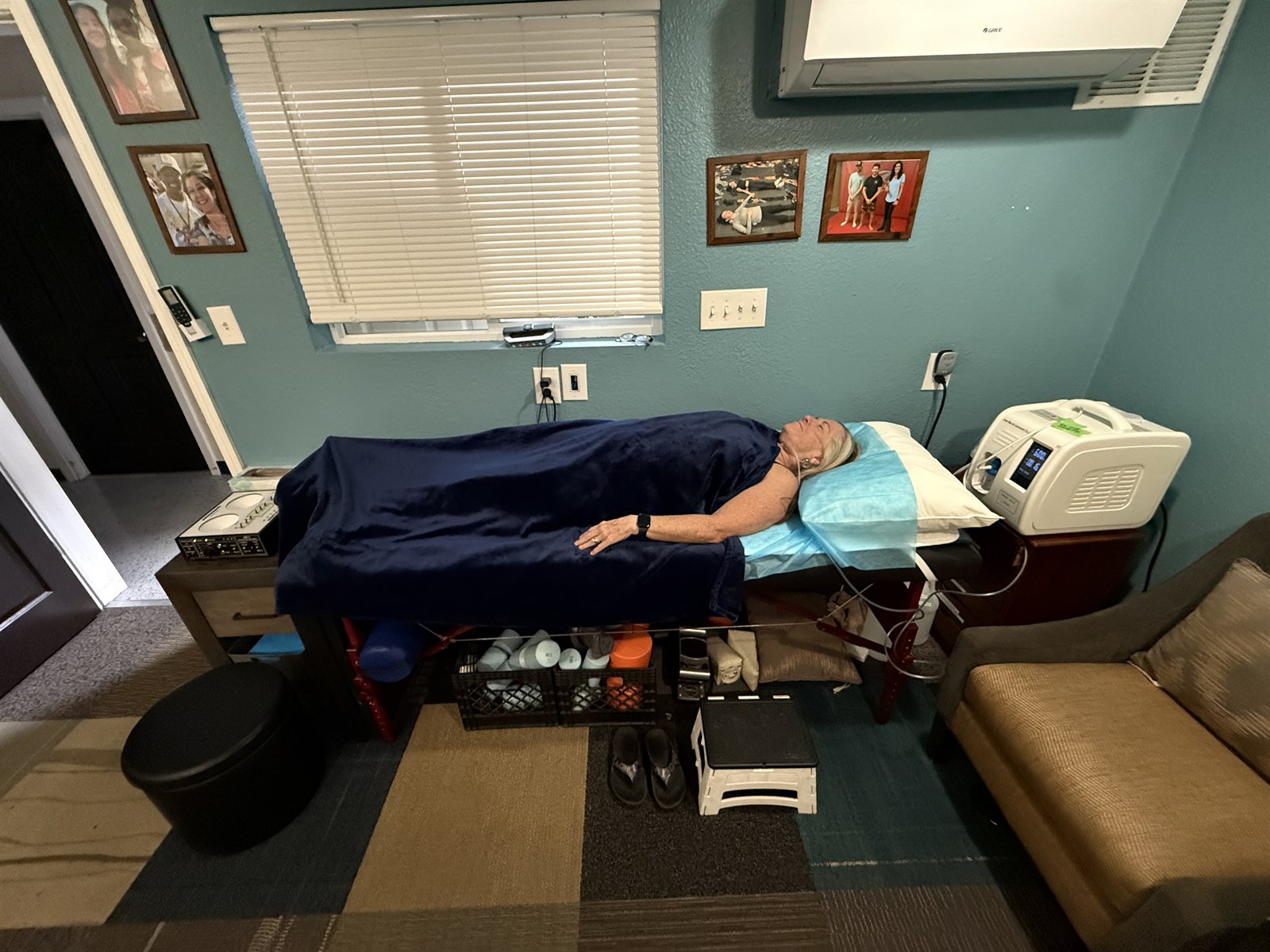
A 2010 paper by Ezra, Dang and Heuser in the European Journal of Clinical Microbiology and Infectious Diseases states: “mHBOT uses 1.3 ATA compared to 2-3 ATA in traditional chambers.” The same paper describes the oxygen in the mild chambers it studied as “mildly elevated from 21% in air to 24%”, against 100% oxygen in traditional chambers. The Kennewick chamber is a soft-sided chamber at 1.3 ATA, with an oxygen concentrator supplying enriched air through a nasal cannula. Clinical hyperbaric oxygen therapy at 2 to 3 ATA is a medical procedure delivered in hospital settings; the center’s sessions are a wellness service.
Boyle’s law: the ears and sinuses
Boyle’s law, as stated in the OpenAnesthesia reference of the International Anesthesia Research Society: “At a constant temperature, the volume of a gas is inversely proportional to the pressure exerted on it.” The middle ear and the sinuses are air spaces inside bone. At 1.3 ATA, air in a closed space shrinks to 1 divided by 1.3, about 77% of its sea-level volume, unless more air enters. While the chamber pressurizes, the higher outside pressure presses the eardrum inward until air enters the middle ear, which is the pressure felt during compression.
Equalizing the ears lets air flow into the middle ear until the middle-ear pressure equals the chamber pressure, which restores the volume that compression reduced. The chamber pressurizes gradually so you can equalize at your own pace, using the techniques reviewed at orientation, and on the way down to 1 ATA the air in the middle ear expands again and vents out. You can depressurize and exit at any time.
Dalton’s law: more oxygen molecules per breath
Dalton’s law of partial pressures states that each gas in a mixture contributes a partial pressure equal to its fraction of the total pressure. Air at sea level is about 21% oxygen at 1 ATA, so oxygen supplies a partial pressure of about 0.21 atmospheres. The same air at 1.3 ATA supplies about 0.27 atmospheres of oxygen, 30% more, because each breath holds 30% more gas molecules in the same lung volume. At the 24% oxygen that Ezra and colleagues describe for mild chambers, the oxygen partial pressure at 1.3 ATA is about 0.31 atmospheres.
Henry’s law: oxygen dissolved in plasma
OpenAnesthesia states Henry’s law as: “the amount of gas that dissolves in a liquid is directly proportional to its partial pressure.” Blood carries oxygen 2 ways: bound to hemoglobin in red blood cells, and dissolved in plasma, the liquid part of the blood. The same reference gives dissolved plasma oxygen as 0.3 mL per deciliter at sea level breathing air, and a higher value at 3 atmospheres, a hospital-chamber pressure. Henry’s law sets the direction at 1.3 ATA: a higher oxygen partial pressure in the lungs means more oxygen dissolved in the plasma than at 1 ATA. Dissolved oxygen travels with the plasma itself, independent of red blood cells.
Screening for a pressurized chamber
Boyle’s law is why ear and lung items are on the screening list: pressure changes the volume of air in the middle ear, sinuses and lungs. Every guest completes a health questionnaire and equipment orientation, following the manufacturer’s screening guidance, and clearance from your healthcare provider comes first for pregnancy, certain lung or ear conditions, recent ear surgery, or an implanted medical device.
Session length and booking
Many members use the session as quiet, screen-free time: you lie on a grounded mat, fully clothed in cotton with shoes off, and no electronics go into the chamber. A booked session is 90 minutes for $100, including gradual pressurization and depressurization; a membership session is 1 hour, with 1 session a month on the monthly membership and 4 a month on the annual. The free Thursday session for new visitors, 2 to 6 PM, rotates among the BioCharger NG, the 7 Wave light panel, Brown’s Gas, PEMF and the hot exercise room. Spinal Fitness Health and Wellness Center is at 214 E. Albany Ave, Building E101, Kennewick, WA 99336, serving Kennewick, Pasco, Richland, West Richland, Benton City and Walla Walla. Call or text 509-670-9713. Eileen Durfee founded the center, has worked in the health field since 2010, and is a NASM Certified Personal Trainer.
This article is for educational purposes only. Mild hyperbaric sessions are offered as a wellness service for general well-being.