What the Body Does in the Kennewick Hot Room: Blood Flow, Heart Rate, Sweat and Recovery

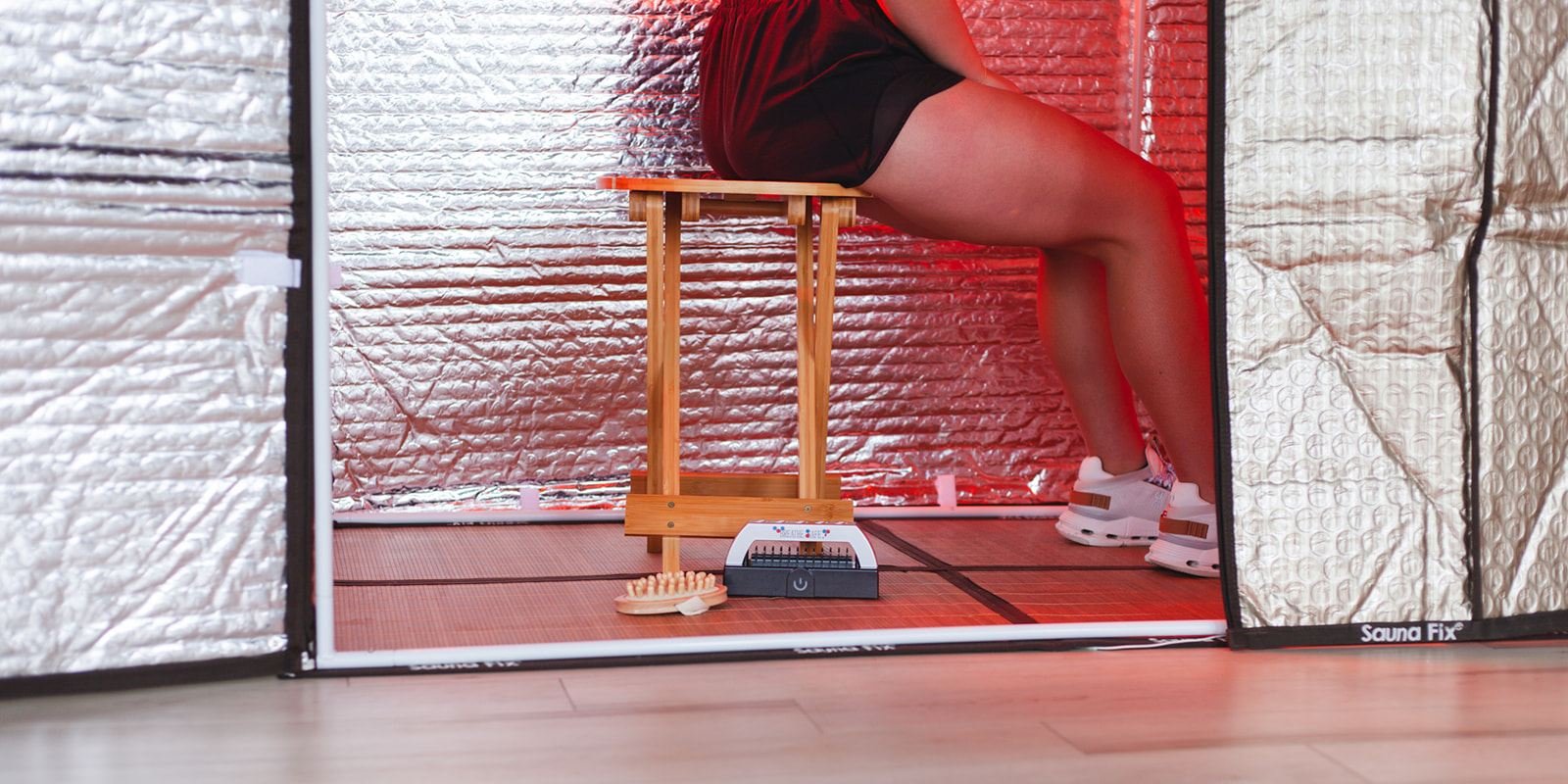
Chapter 20 of Eileen Durfee’s book, Spinal Fitness, states that heat increases circulation by widening blood vessels and increasing blood flow to muscles, fascia and joints. The hot exercise room at Spinal Fitness Health and Wellness Center in Kennewick, WA applies that heat through a low-EMF Sauna Fix radiant tent emitting 550 to 3000 nm light and radiant heat, with no traditional preheat period and a maximum of 155°F, for sessions of 20 to 40 minutes.
1. Blood vessels widen and blood flow rises
The book’s description of the mechanism: heat widens blood vessels and increases blood flow to muscles, fascia and joints. Blood carries oxygen, nutrients, minerals and repair factors into tissue and carries inflammatory byproducts and metabolic waste out. The book adds that chronically stiff or guarded tissue often has poor local circulation, which slows recovery and makes tissue resistant to change. In the hot room the heat reaches the body as radiant heat from the incandescent bulbs, with no traditional preheat period.
2. Heart rate rises
The book cites a review in Mayo Clinic Proceedings that summarized evidence linking sauna bathing with cardiovascular and other health outcomes, including increased heart rate, vascular effects and relaxation responses. Its application: for a person rebuilding spinal function who cannot yet exercise intensely, heat provides a controlled heat stress that increases circulation and cardiovascular demand without loading the spine the way weight-bearing exercise does. The room’s page states: “Exercising in radiant heat is an intense training environment”, with duration and effort built gradually.
3. Heat shock proteins
The book states that heat stimulates heat shock proteins, which it defines as protective cellular stress-response molecules that help protect cells, assist with protein folding and support cellular repair. The book states: “Controlled thermal stress, like controlled mechanical stress, teaches the body to become more resilient.” Its dose for a pre-training session is typically 10 to 15 minutes at comfortable intensity, and its safety rule is “Begin gradually. Short sessions are more effective than overdoing it.”
4. Sweat, and the minerals in it
The book describes sweat as one of the body’s elimination pathways, carrying water, salts, metabolic waste and some unwanted compounds out through the skin. When the body sweats, minerals are also lost, and a person using sauna therapy regularly should replace sodium, potassium, magnesium and trace minerals, not only water. The book states that the sodium-to-potassium relationship governs cellular electrical potential. The book places sodium mainly outside the cell and potassium inside, and lists that relationship as governing nerve function, fluid regulation, nutrient transport and waste removal. On a hair chart, Trace Elements, Inc. puts the ideal sodium-to-potassium ratio at 2.4 and Analytical Research Labs at 2.5. The book reads a low sodium-to-potassium ratio as a depletion trend, and states that a person with that pattern may not tolerate aggressive detoxification or intense training.
Light in the same session
The room’s page gives the tent’s output as 550 to 3000 nm light and radiant heat. The book describes the full-spectrum incandescent source as delivering visible red light, near-infrared light, and mid-infrared and far-infrared heat. In the book, near-infrared wavelengths interact with cytochrome c oxidase, an enzyme in the mitochondrial electron transport chain involved in oxygen consumption and ATP production. Red light primarily reaches superficial tissue, and near-infrared light penetrates more deeply into muscles, fascia, joints and nerves. Eyewear is worn for the full 20 to 40 minutes, and the book calls for eye protection with bright incandescent light.
Stop signs during the heat
The room’s page names 5 signs to stop exercising: dizziness, nausea, confusion, unusual shortness of breath and faintness. The book’s sauna chapter names dizziness, weakness, headache, racing heart, nausea and unusual fatigue as signs to stop, cool down, hydrate and reassess. Before first use, every member completes a safety screen and receives hydration guidance.
Recovery after the session
The book’s after-session sequence is to shower and rehydrate with minerals, and its safety list states the same rule as “Rehydrate with mineral-containing fluids, not plain water alone.” The book classifies hair-chart patterns by oxidation type. Slow oxidation in the book is calcium-to-potassium above 4 to 1 with sodium-to-magnesium below 4.17 to 1; its guidance is shorter sauna sessions at first to avoid depletion. Fast oxidation is calcium-to-potassium below 4 to 1 with sodium-to-magnesium above 4.17 to 1; its guidance is careful sauna dosing, since excess heat may further stress the system if minerals are not restored. The center offers hair tissue mineral analysis at $270, processed by Trace Elements, Inc., for members who want to read that pattern. Trace Elements, Inc. and Analytical Research Labs place the 2 ideals at calcium-to-potassium 4.2 and 4, and sodium-to-magnesium 4 and 4.17. When the 2 ratios move in opposite directions, the book calls the pattern mixed oxidation and reads it with retesting and symptom tracking over time.
Using the room in Kennewick
Spinal Fitness Health and Wellness Center is at 214 E. Albany Ave, Building E101, Kennewick, WA 99336, serving Kennewick, Pasco, Richland, West Richland, Benton City and Walla Walla. Call or text 509-670-9713, evenings and weekends included. The $150 Month-to-Month membership includes the near-infrared saunas and the general and spinal fitness equipment, including a PowerCore Stepper, an elliptical, a Bowflex TreadClimber and a bicycle. Members use the room 24/7 with a door code issued once training is complete. Every Thursday from 2 to 6 PM the center is open to new visitors for a free session, and the hot room is 1 of the 5 services in that rotation, at up to 40 minutes. Eileen Durfee founded the center and is a NASM Certified Personal Trainer and the inventor of Spinal Fitness.
Keep Exploring
This article is for educational purposes only.